
Portrait of Xiangyu Zhang

Astrophysics · Stanford, California

Xiangyu Zhang 张翔宇

KIPAC Postdoctoral Fellow at Stanford University

Studying the interstellar medium, measuring 3D dust extinction with machine learning, and exploring how polycyclic aromatic hydrocarbons shape the extinction curve across the Milky Way and its neighbours.

  • Gaia
  • JWST
  • SPHEREx
  • DESI
  • Rubin / LSST
Scroll

01

About me

A physics background, a passion for interstellar dust, and a toolbox full of machine-learning models.

I am a KIPAC Postdoctoral Fellow at Stanford University. Before joining Stanford, I completed my PhD at the Max Planck Institute for Astronomy (MPIA) and Heidelberg University in July 2025, then stayed at MPIA as a postdoctoral researcher.

Most of my work lives at the boundary between large stellar surveys and interstellar dust physics: I build data-driven models of Gaia XP spectra, then use them to measure stellar parameters, extinction, and the shape of the extinction curve — in 3D and for tens to hundreds of millions of stars at a time.

Beyond astronomy, I come from Baotou, “the city of deer”. I enjoy spending entire days in history museums learning random historical facts — for instance, how astronomers in the 16th century measured stellar coordinates.

Hun yi (armillary sphere) at the Ancient Observatory in Beijing
This is how astronomers in the 16th century measured stellar coordinates. Shot by me at the Ancient Observatory, Beijing, 2018.

02

Research

Featured projects — from spectra of 220 million stars to the physical origin of R(V).

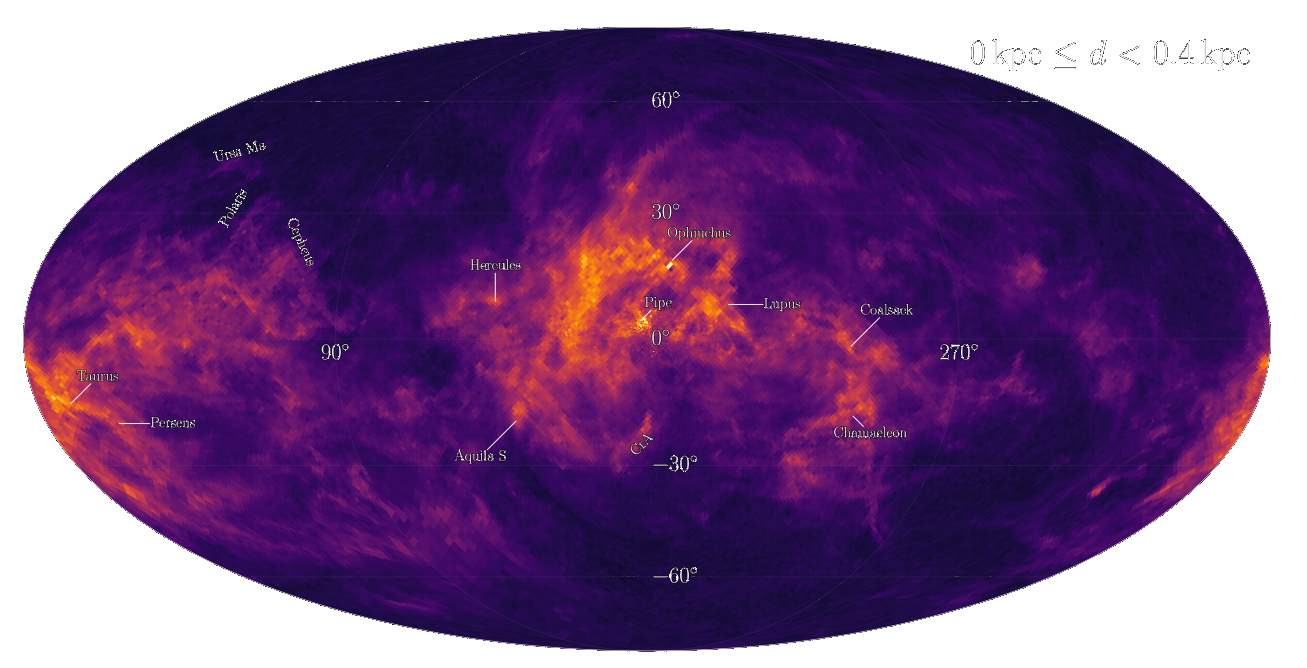
3D dust map visualisation of the Milky Way

2023 · MNRAS 524, 1855

Parameters of 220 million stars from Gaia BP/RP spectra

Gaia DR3 provides low-resolution XP spectra for more than 220 million stars — a unique opportunity to measure dust extinction and its variation in 3D. We built a forward model that maps (Teff, [Fe/H], log g) to Gaia XP, and used it to determine stellar types, extinction and distances for the full sample of 220 million Gaia XP stars.
  • Gaia XP spectra
  • Forward modelling
  • 220M stars
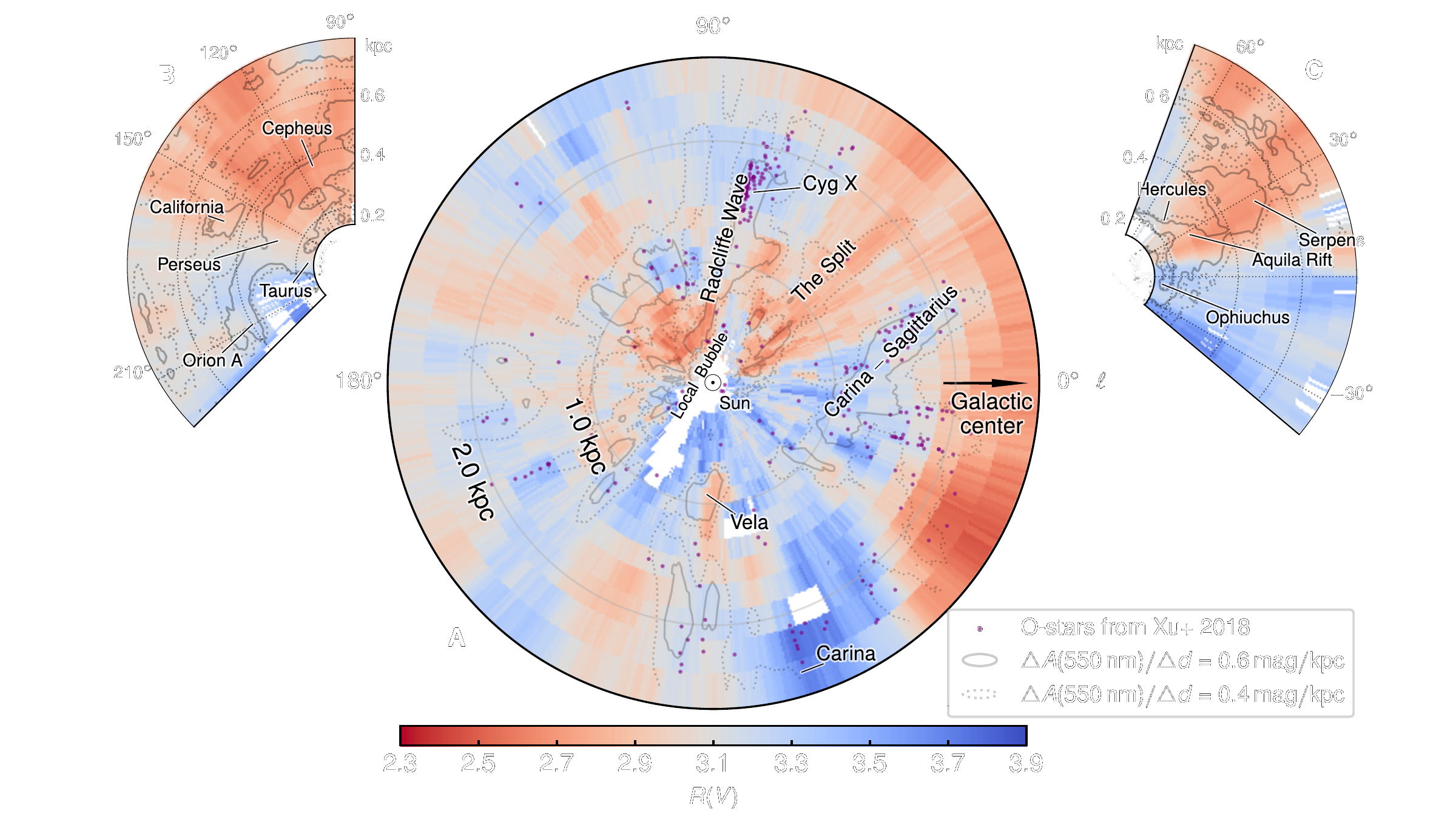
Bird’s-eye view of the Milky Way dust extinction map with O stars

2025 · Science 387, 1209 Cover article

Three-dimensional maps of the interstellar dust extinction curve

The shape of the extinction curve is set by the size distribution and chemical composition of interstellar dust, so R(V) (≡ A(V)/E(B−V)) traces the local physical and chemical environment — supernovae, star formation and molecular clouds. Using Gaia XP spectra, we determined R(V) for roughly 130 million high-extinction stars in the Milky Way, LMC and SMC: the largest R(V) catalogue of its kind up to 2024.

  • 130M stars
  • 3D R(V) maps
  • Milky Way · LMC · SMC
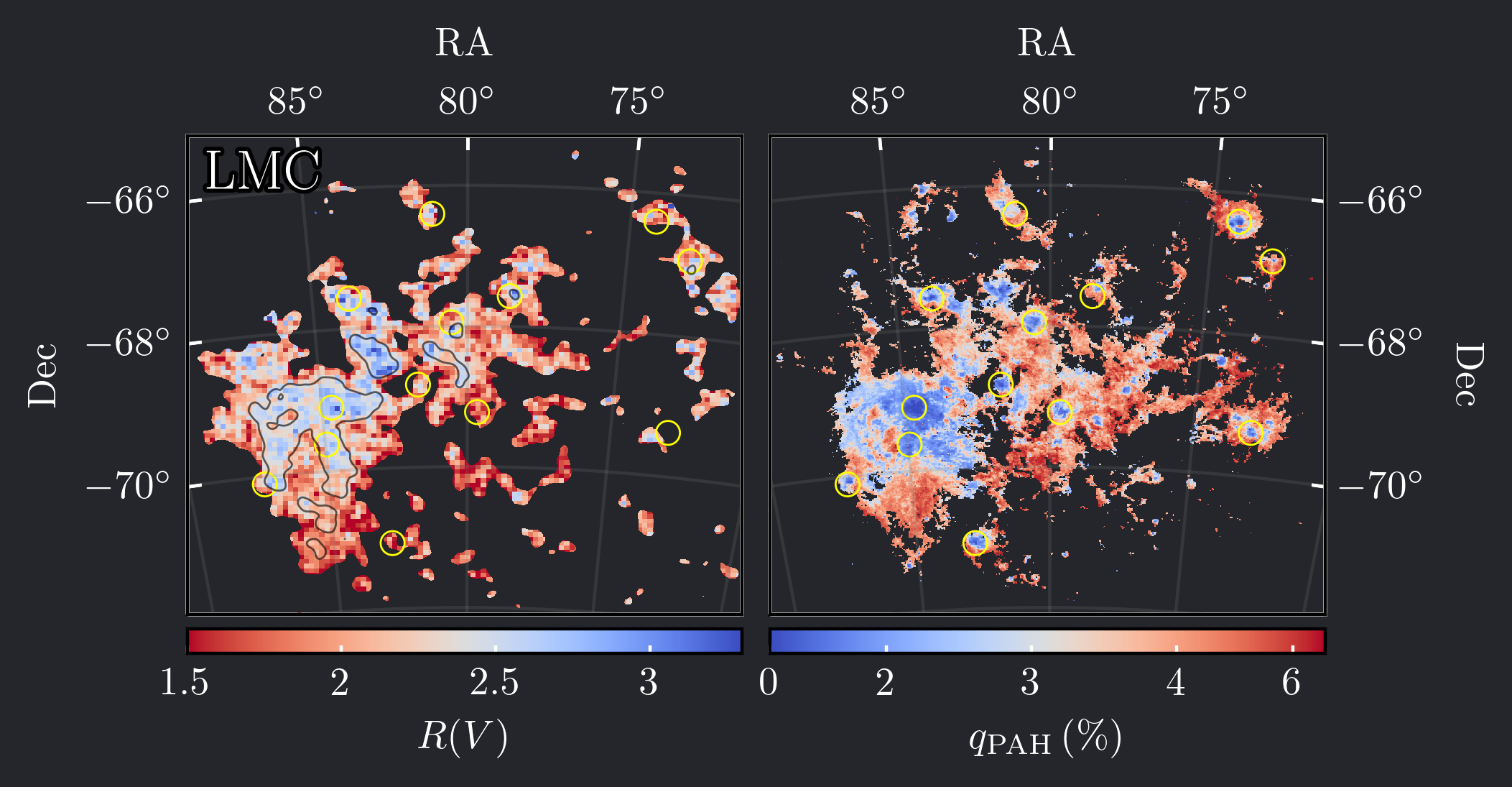
Map of R(V) towards the Large Magellanic Cloud

2025 · ApJL 979, L17

R(V) variation is driven by polycyclic aromatic hydrocarbon growth

We find observational and theoretical evidence that PAH-driven growth shapes R(V) in the translucent interstellar medium, where R(V) anti-correlates with PAH abundance. Growing PAHs strengthen the 2175 Å feature; its red wing raises B-band extinction while barely affecting the V band — pulling R(V) down. If confirmed, this picture has implications well beyond extinction corrections, including the anomalously low R(V) values seen toward Type Ia supernovae.

  • PAH growth
  • 2175 Å bump
  • Translucent ISM

03

Selected publications

First-author work featured on this page. Everything else lives in my ADS library.

  1. Three-dimensional maps of the interstellar dust extinction curve within the Milky Way galaxy

    Science 387, 1209 · Cover article

  2. Dust-extinction-curve variation in the translucent interstellar medium is driven by polycyclic aromatic hydrocarbon growth

    The Astrophysical Journal Letters 979, L17

  3. The dust extinction curve: beyond R(V)

    The Astrophysical Journal 988, 5 · Green, Zhang & Zhang

  4. Parameters of 220 million stars from Gaia BP/RP spectra

    Monthly Notices of the Royal Astronomical Society 524, 1855

04

Talks

A few seminars, conferences and institute science days from the last few years.

  1. 2025

    Mapping dust extinction beyond stellar color

    Harvard–Smithsonian Center for Astrophysics (CfA) · October 2025

  2. 2025

    Searching for interstellar organics in translucent dust clouds

    MIT Department of Chemistry · October 2025

  3. 2025

    3D dust mapping and interstellar organics

    DESI lunch talk · LBNL / UC Berkeley · October 2025

  4. 2025

    An all-sky 3D dust R(V) map of the Milky Way: insights into interstellar organics

    KIPAC Tea talk · Stanford University · September 2025

  5. 2025

    3D dust mapping and its implications for interstellar organics

    Interstellar Institute · Université Paris-Saclay · July 2025

  6. 2025

    Mapping R(V) in 3D in the Milky Way, LMC and SMC

    NAOC invited talk · National Astronomical Observatories, CAS · March 2025

  7. 2024

    R(V) variation in 3D and its implications for dust evolution

    Caltech · June 2024

  8. 2023

    Inferred stellar parameters from 220 million XP spectra using an empirical forward model

    KIAA Seminar · August 2023 · Peking University, Beijing

    Seminar announcement ↗
  9. 2023

    Inferred stellar parameters from 220 million XP spectra using an empirical forward model

    NAOC Seminar · August 2023 · National Astronomical Observatories, Beijing

    Seminar announcement ↗
  10. 2023

    A 3D R(V) map based on Gaia XP spectra

    Invited talk · August 2023 · Department of Astronomy, Tsinghua University, Beijing

  11. 2023

    Stellar parameters from Gaia XP spectra using a forward model

    Gaia XPloration · May 2023 · Institute of Astronomy, Cambridge

  12. 2022

    Stellar parameters of 220 million stars from Gaia XP spectra

    MPIA Science Day · December 2022 · MPIA, Heidelberg

  13. 2022

    Variation of extinction curves from PS1, 2MASS, WISE & Gaia

    Interstellar Institute · July 2022 · Institut Pascal, Saclay

05

Observations

Approved proposals where I am principal investigator.

GBT · K-band · 18–26.5 GHz 30.0 h

Detecting HC3N in M31: verifying extragalactic in-situ PAH formation

Group A · linear ranked score 2.41 / 10

GBT · K-band · 18–26.5 GHz 5.0 h

Tracers of PAH formation at the edges of molecular clouds: source verification

Group A · linear ranked score 0.65 / 10

06

Get in touch

Questions about my work, collaborations or data products? I’d be happy to hear from you.

Office

  • astrozxy@stanford.edu
  • Kavli Institute for Particle Astrophysics and Cosmology (KIPAC), Stanford University
    Stanford, California, USA